Media library management
Open a photo and video library for a local government body
Photos, video, council recordings and a press desk in one media library.











A photo and video library for a local government body keeps photos, video and council recordings together in Videas Mediasbox, hosted in the EU, with a workspace per department and fields such as credit and usage rights. Residents watch the recordings freely, and journalists request high-resolution files from a press library and download them once the body approves.
“Rives d’Arnelle” is a group of local councils invented for this walkthrough: 32 towns and around 110,000 residents. Sophie Lambert runs communications, Nadia Benali looks after the photo library, Thomas Rey films.
A photo library scattered across USB sticks
The photos lived on a file server and on USB sticks, and heavy files went to the press through a transfer service.
The council recordings sat on a consumer platform: advertising in front of a public meeting, trackers dropped on residents, data outside the EU.
A photo and video library hosted in the EU
The files are hosted in the EU, GDPR compliant and with a dedicated DPO, and the player serves no advertising and no third-party tracker.
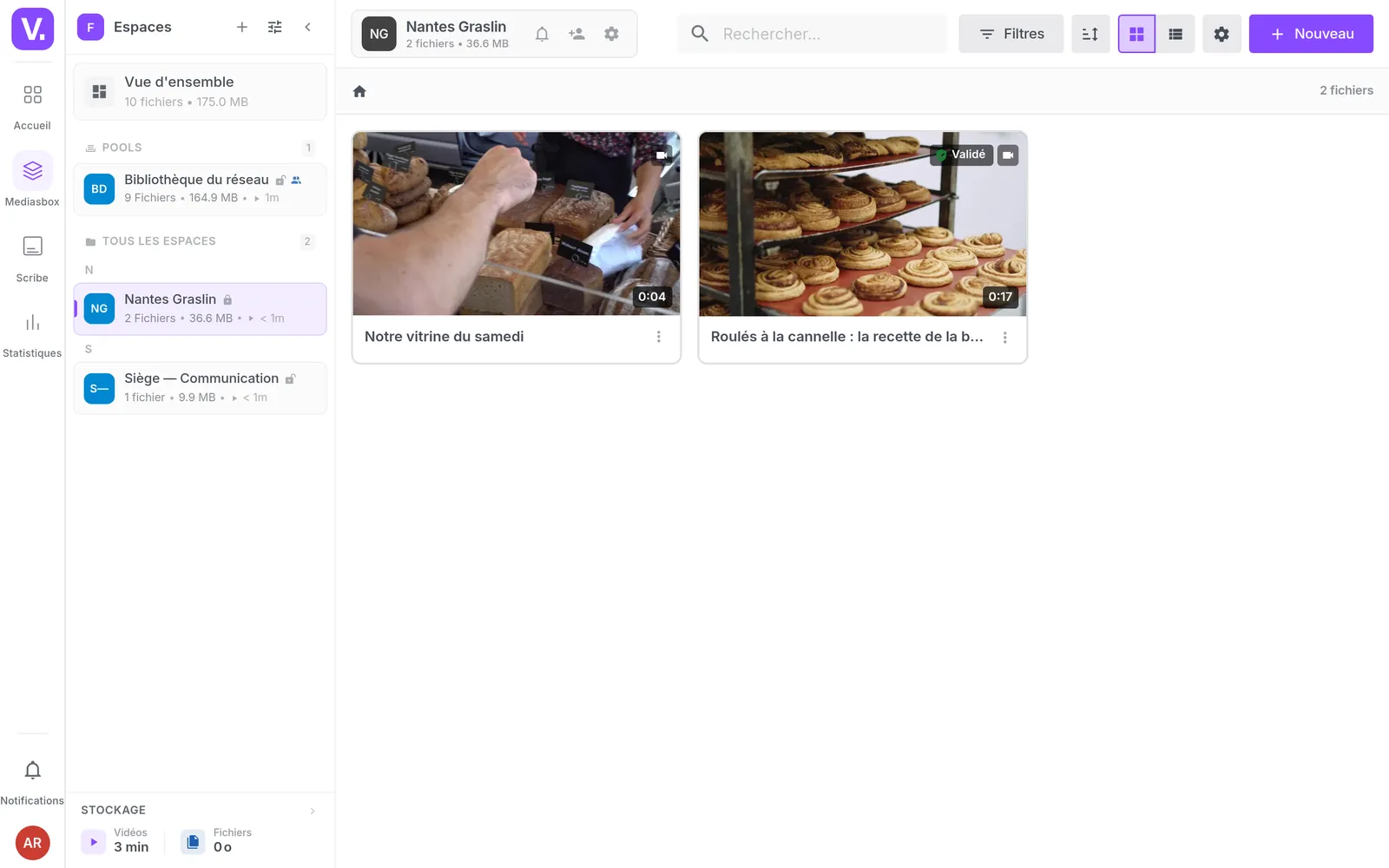
Everything is filed in a DAM (digital asset management): a library with a workspace per department, keywords and fields of the body’s own, photographer credit and usage rights among them.
It is the council recordings that set the real requirement: two hours of video are no use unless you can get into them. The player is built to RGAA good practice: subtitles, transcript, chapters from the agenda, adjustable subtitle size, full keyboard control. The detail is in the accessibility scenario.
One library, open to each audience on its own terms
One holding, three publics. Residents open the recordings and the area’s videos freely. Staff keep their own, induction and leadership messages, in a protected workspace only their members see.
Journalists see what exists before asking for it: an item “on request” stays visible as a preview. Julien Perrin gathers what he needs, explains what it is for, and the body approves or refuses, with an end date for the access if it wants one. The regulars go into a “Press” group, which opens a whole section with no request at all.
How it works, step by step
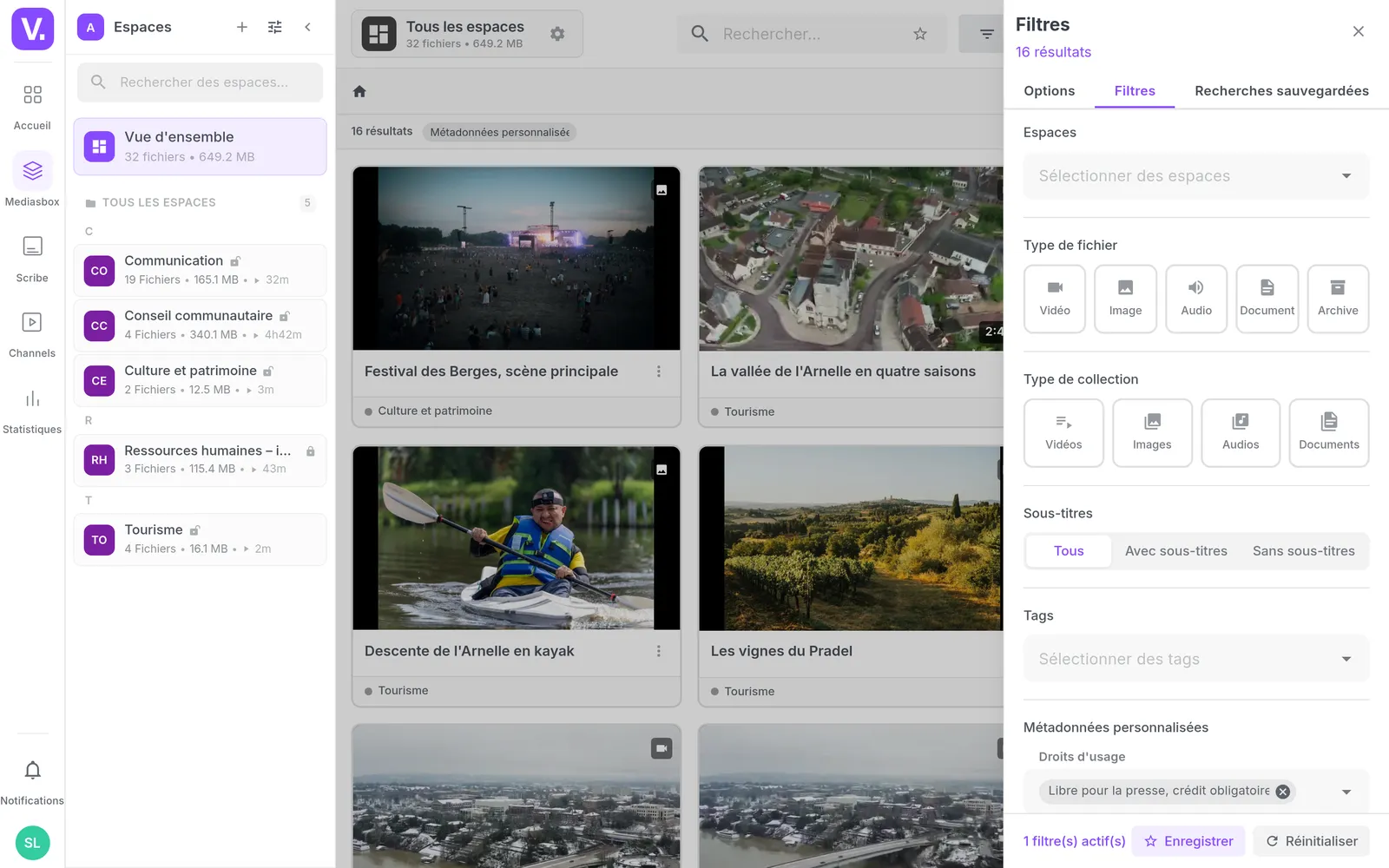
The media library
Photos and video in the same library, a workspace per department on the left. The filters combine file type, keywords and fields of the body's own, here usage rights.
A photo and its metadata
Credit, usage rights, town, date taken and theme. The breadcrumb says where the photo is filed.
The council meeting, cut by item
The chapters follow the agenda, typed in or proposed from the transcript. Meetings are filed by mandate.
The public recording
The same meeting on the body's site, freely accessible, with its subtitles and its clickable agenda items. The resident goes straight to what concerns them.
The press library
The site's Press desk section. Files stay visible as previews, badged On request: the journalist sees what exists before asking for it.
The journalist's request
Julien Perrin gathers three files and explains what they are for, as he would fill a basket.
The access requests
On the body's side, the pending requests with their message, to approve or refuse. The decision covers the whole request.
The high-resolution download
Once the request is approved, the journalist gets the original file, with the credit to cite in front of them.
The press pack sent directly
When a delivery cannot wait on a request, a protected link does the job: an expiry date, and a count of how often it was opened.
Public bodies that have done it
Rives d'Arnelle is invented; these three organisations are not: a city, a network of regional video libraries and a public agency, with their real constraints.
City of Roubaix
Hosting its videos in the EU, with no cookie banner — City of Roubaix
A city in northern France, Roubaix used to publish its videos on a consumer video …
France Travail
Opening 26 autonomous regional video libraries under one administration — France Travail
France Travail deployed Videas to create dedicated video libraries for each of its regional offices …
ONISEP
Managing 4 TB of video and hundreds of autonomous partners — ONISEP
ONISEP, a major player in career guidance in France, entrusted Videas with the hosting and …
What our customers say about us
Videas provides exactly what we needed: uncompromising security for our premium content, native GDPR compliance, and an integration simplicity that saves our educational teams valuable time.
Videas enabled us to structure our video communications at the national level while giving each region the tools to operate independently. GDPR compliance and accessibility were non-negotiable prerequisites, and Videas delivers them natively.
Videas enabled us to centralize the management of thousands of educational videos while simplifying interactions with our partners. The ONISEP TV platform has become an essential tool for distributing our content to millions of students and families.
Frequently asked questions
Can photos and video live in the same library?
Yes, in one media library with a workspace per department, filed in folders and described with the same fields. A photographer's shoot and a council recording sit in the same place, and the filters cover both.
Where are a public body's photos and videos hosted?
In the EU, GDPR compliant and with a dedicated DPO, and the player serves no advertising and no third-party tracker. The viewing statistics are measured by Videas, not by an ad network.
How do you give journalists high-resolution files?
Through a press library where each item is public, reserved for registered users, or available on request. A file on request stays visible as a preview: the journalist sees what exists, puts what they need in a request, and downloads the original once you approve.
How do you publish council recordings as video?
On the body's public channel, freely accessible, filed by mandate and by year. Chapters follow the agenda, typed in or proposed from the transcript, so a resident goes straight to the item that concerns them.
What information can you attach to a photo?
Title, description, keywords, and custom fields of your own: photographer credit, usage rights, town, date taken, theme. Those fields are set up with the Videas team, and every change is recorded in the file's history.
How do you find the photos you are allowed to reuse?
By filtering on the usage-rights field, when it is a list of choices. The field is one you read and filter on: nothing unpublishes itself when a right lapses, and there is no end-of-rights alert.
Do residents need an account to watch a council meeting?
No: the recordings are open to everyone. Accounts are for the internal side, where staff keep their own videos in a protected workspace only their members can see.
Are the recordings accessible to deaf and hard-of-hearing residents?
The player is built to RGAA good practice: subtitles, transcript, chapters from the agenda, adjustable subtitle size and full keyboard control. It has not been audited, so we call it neither compliant nor certified.
Can you get a written record out of a filmed meeting?
Scribe produces the transcript, your team proofreads it, and it displays under the video and makes the meeting findable by search. It is a working text, not a legal record of proceedings.
Can journalists be given a whole section without requesting?
Yes, by putting the regulars in a group: the group opens an entire section, so they stop filing a request for every file. The ones who come once a year keep going through requests.
More scenarios
All scenarios →Private companies
Sell your conference recordings all year round
Recorded talks become a catalogue that keeps selling all year.
Private companies
Take your local TV station online, on a channel of its own
The live stream, the shows on replay and fifteen years of archive together.
Private companies
Run a shared video library across your whole network
A workspace per location, a shared library head office moderates.