The 6 best video platforms with an API in 2026
Every video platform with an API now ships much the same endpoints, so the API itself no longer separates them. What does is how much you still have to build once it is wired in. Videas automates without taking the interface away from everyone else, Brightcove puts your video in your own TV and mobile apps, Mux is the infrastructure brick developers reach for, Cloudinary has you delivering by the afternoon, Bunny Stream prices delivery by usage and serves it close to the network, and Cloudflare Stream puts video inside infrastructure you already run.
Some of these hand you an infrastructure and leave the back office, the media library and the screens your colleagues will actually open as your project. Others hand you those screens and open the API on top. Here’s each one.
1) Videas: the API on top of the interface, not instead of it
Videas opens a public REST API that does by code what you would otherwise do by hand: read everything the library holds, drop in a file or a video hosted elsewhere, fix a title, a description, tags or a thumbnail, publish a piece to a channel on the date you choose, pull its embed code, and read back the viewing figures. The reference gives every call in cURL, Node.js and Python, ready to copy.
What sets it apart is what happens next to the API. A video sent by code lands in the same library as one uploaded by hand, and the rest of the team carries on inside the interface: subtitles in Scribe, statistics, channels, a player in your colours. So you never have to build the screens your colleagues will use, which is the hidden invoice of a purely API-first platform.
Two things matter on the day the integration goes live. An access key belongs to the organisation rather than to whoever created it, so it keeps working after that person leaves. And you tick the actions it is allowed to perform one by one, with everything that writes left unticked by default: a key that can change your content is always created on purpose. The rest, from error handling to rate limits, is in the getting-started guide and the limits page. To skip writing the HTTP calls by hand, two official SDKs cover the whole API: @videas/sdk for JavaScript and TypeScript, and videas for Python. For any other language, the OpenAPI 3.1 contract downloads to generate a client.
2) Brightcove: native TV apps, quoted and annual
Brightcove covers the whole span of enterprise video, API included: catalogue management, player, analytics, live, monetisation, and an ecosystem of integrations into the big tools. What sets it apart is its native OTT apps: a channel under your own brand on Apple TV, Android TV, Roku, Fire TV and the mobile app stores, without building an app yourself.
You pay for it in buying terms. The offer is quoted rather than priced, on an annual commitment and a project-mode rollout: you will not learn the price without talking to a salesperson, and you will not scale down mid-year. The interface is powerful but demanding, and each extra need tends to arrive as one more module. Our Brightcove comparison goes through what that purchase actually involves.
3) Mux: the infrastructure brick for developers
Mux is the reference for video infrastructure driven by API: ingest, transcoding, HLS delivery, live and playback data all come back from clean, well-documented calls, with dependable webhooks to follow an encode. It is what teams pick when video is a component of the product they are building and they want exactly that behaviour and nothing else.
The flip side is that everything else is yours to write. Without a technical team nothing goes online: there is no editorial interface, the player is yours to embed, and the back office your colleagues will ask for in month two is your project, not theirs. Billing follows the same logic, with encoding, storage, delivery and processing metered apart, which makes the month hard to forecast before you have lived one. Our Mux comparison lays out that division of labour.
4) Cloudinary: delivery wired in by the afternoon
Cloudinary treats video as one media type among several, and that is its strength for a developer in a hurry: upload through an API, transform and transcode through the URL itself, deliver adaptively, drop in a player, all with client libraries in most languages and documentation that gets to the point. If your product already leans on it for images, adding video costs almost nothing in new concepts.
Its limits follow from the same premise. It is a media pipeline, not a video platform: no catalogue your audience can browse, no rights by team, no reviewed subtitles, no monetisation. And because transformations, storage and bandwidth are metered together through credits, a video workload can move the bill in ways an image workload never did.
5) Bunny Stream: usage-priced delivery, close to the network
Bunny Stream suits teams that want a simple API sitting on a dense delivery network at a cost that tracks usage. Ingest, transcoding, the player and playback statistics come through the API or a technical dashboard, and the video library is organised into collections. For serving a large catalogue without building infrastructure, it is ruthlessly effective.
Two reservations for a non-technical buyer. Everything goes through the API or that dashboard, so nothing is designed for an editorial team day to day, and there is no CMS plugin or ready-made LMS integration, which means putting a video into WordPress or Moodle is an integration you write. The statistics, for their part, stop at playback: no contact capture, no campaign attribution. Our Bunny comparison covers the rest.
6) Cloudflare Stream: video inside infrastructure you already run
Cloudflare Stream has an argument the others do not: if your traffic already passes through Cloudflare, video joins a contract, a dashboard and a security model you know. The API covers ingest, automatic transcoding, worldwide delivery, live and signed URLs, and billing by minute stored and minute delivered is among the easiest on the market to model.
Its limits are those of an infrastructure product inside a broad catalogue. The player works but barely customises, the statistics stay thin next to a specialist platform, and there is no media library, no rights by team, no reviewed subtitles and no public channel. Stream delivers very well; it does not run a company’s video library.
FAQ
What is a video platform with an API?
A hosting and delivery platform whose actions a program can trigger instead of a person: send a video, follow its encode, change its metadata, publish it, fetch its embed code, read its statistics. It lets your own catalogue stay in step with the platform without anyone retyping anything. The general definition sits in our glossary entry on the API.
Do you need developers to use a video platform with an API?
It depends on the platform, and that is the real deciding factor. With API-first services such as Mux, Cloudinary or Bunny Stream the API is the only way in: without a developer, nothing goes online. With Videas or Brightcove the API automates what the interface already does, so a non-technical team keeps working while a developer wires up what needs wiring.
Which video API is best for a developer?
For a pure infrastructure brick, Mux and Cloudinary are the most pleasant to integrate. For video that also has to live in non-technical hands, the Videas API gives you the same automation without forcing you to build the back office around it. The useful question is not which API is best, but how much code is left once the integration is done.
What can you automate with the Videas API?
Reading the organisation's library, adding a file or a video hosted elsewhere, changing text, tags, custom fields and thumbnails, publishing to a channel now or on a future date, fetching an embed code, and reading playback sessions. The usual cases are syncing with a CMS, bulk importing from an LMS, and feeding a web TV from an internal tool.
Is an API enough to put a video online?
No, and that is the most common framing mistake. An API sends and delivers; it does not decide who may publish, does not show your audience a catalogue, does not review your subtitles and does not file your content by team. All of that either exists in a complete platform, or becomes a development project of its own.
Every API on this list can upload, encode and deliver a video. What separates them is what you still have to build once the integration is written. With Videas, not the back office: the media library, reviewed subtitles, analytics and channels are already there for the colleagues who will never open a terminal, and the API automates what they do instead of making you build the screens they need. An infrastructure brick like Mux or Cloudinary makes sense when video is one component of a product you build end to end, and Brightcove when the company already runs on it.
Related articles
Video Platform
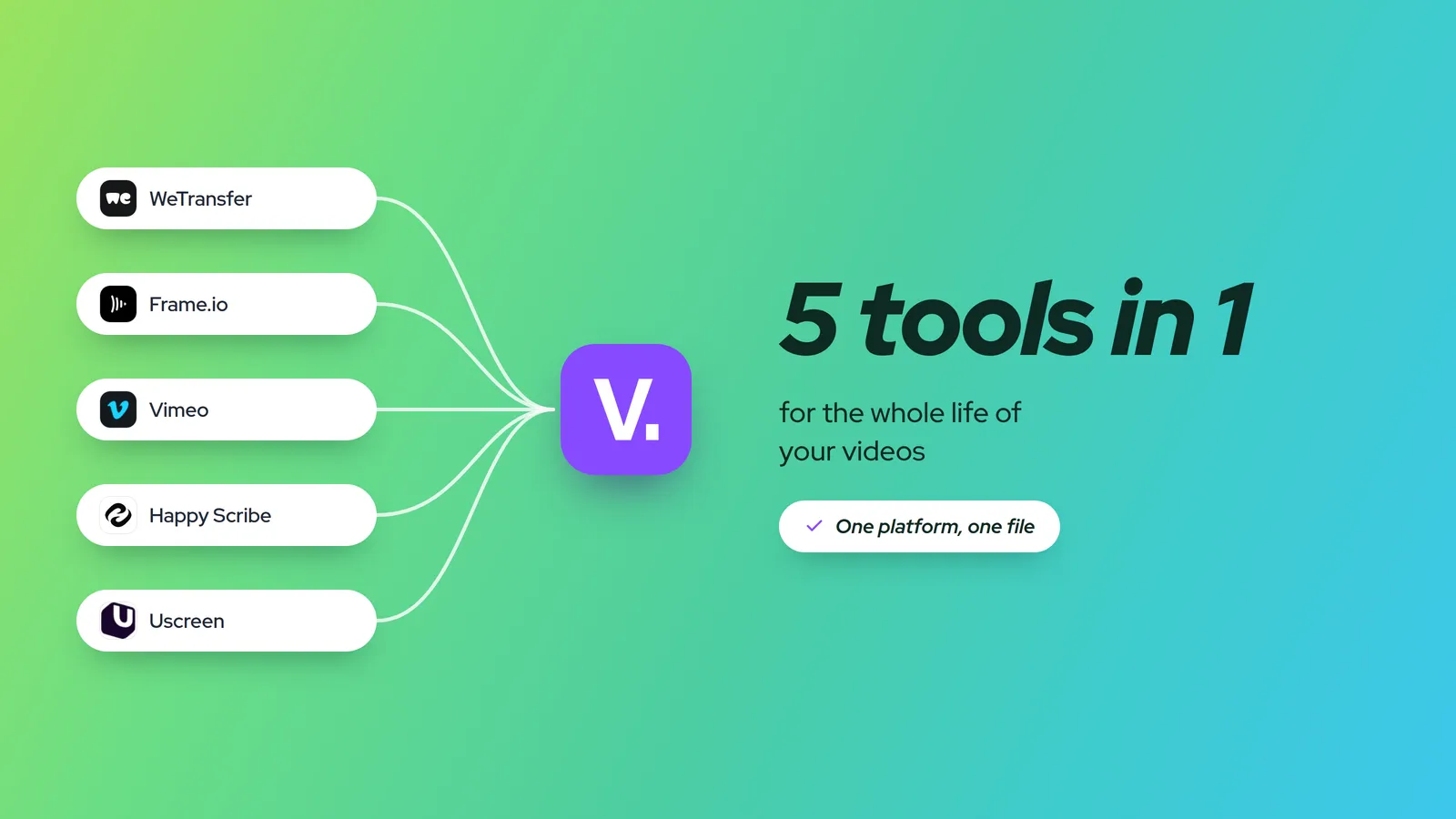
5 tools in 1: your whole video workflow in one place
Sending, review, hosting, subtitles, sales: a single video still travels through five platforms before anyone watches it. How the whole chain fits into one.
Video Platform
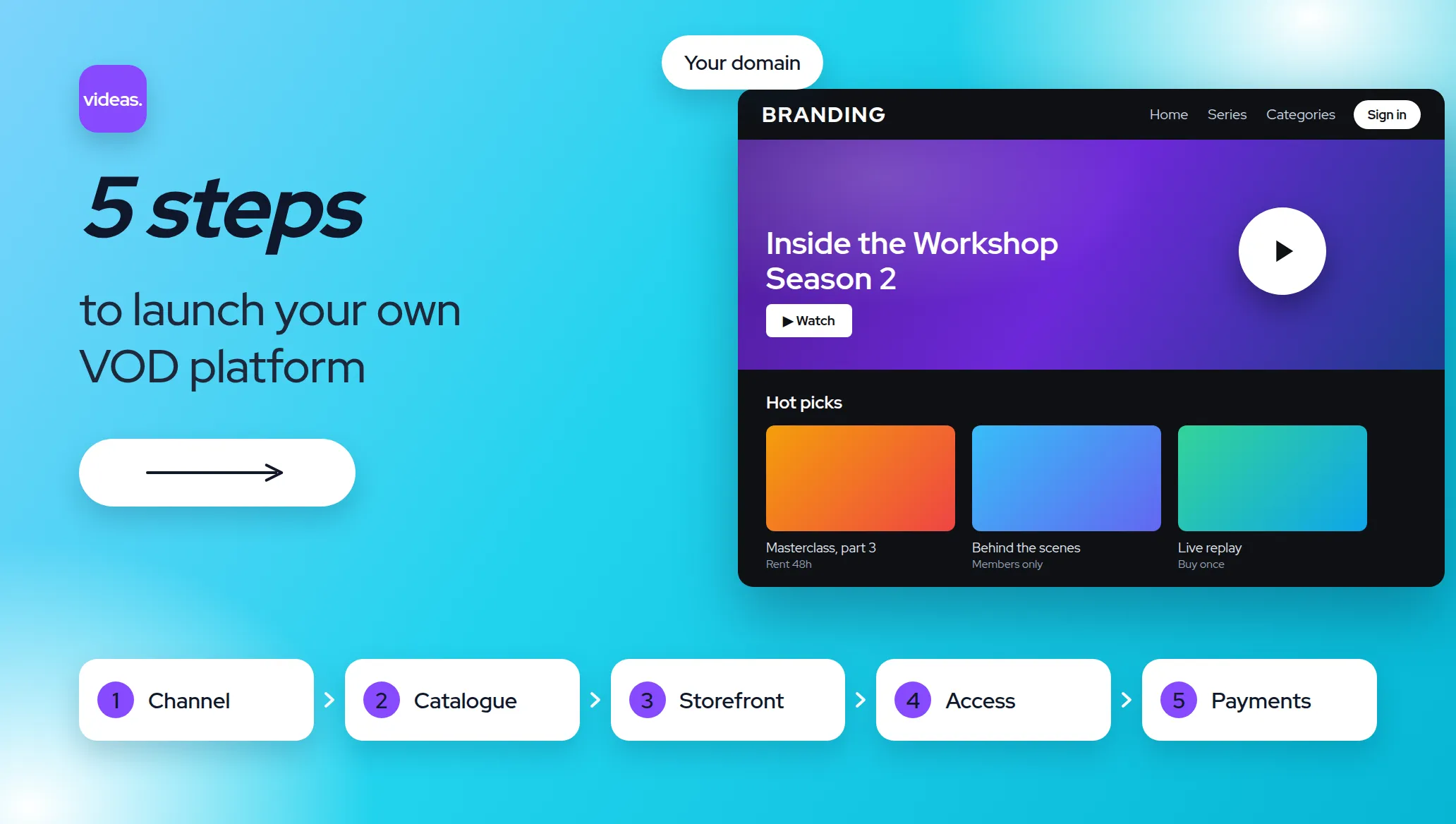
Create your own VOD platform in 5 steps
Creating a VOD platform takes 5 steps and, with Videas Channels, a single day if your videos are ready: open your channel, sort your catalogue, compose the storefront, decide who sees what, then set your prices.
Video Platform
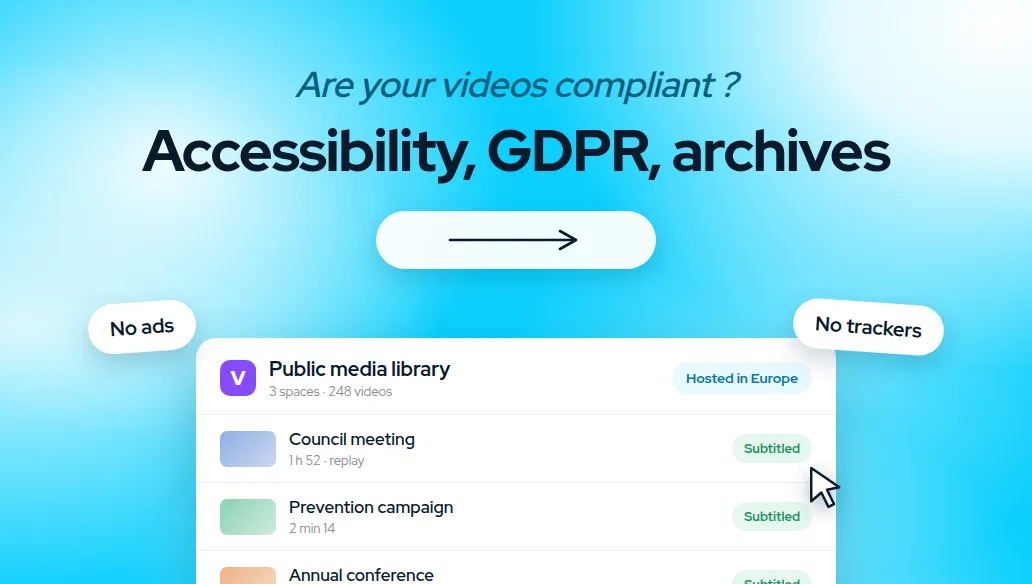
Publishing video in the public sector: the 3 rules to follow
Three rules govern video published by a public body: accessibility, data protection, archiving. EU hosting, an ad-free player: what to check before choosing.